Posts mit dem Label B: Ölindustrie werden angezeigt. Alle Posts anzeigen

Mittwoch, 3. Juli 2013

Benzinknappheit die x..te


Und wie das Amen im Gebet (eigentlich das Alahu Akbar bei der Predigt) kommt auch wieder einmal eine kleine Treibstoffkrise auf. Diesmal (wie auch etliche male davor) war ein vor drei Tagen begonnener Streik in Zawiah dafür ausschlaggebend. Die Bevölkerung ist beunruhigt, dass das Bestreiken einer Raffinierie die Nachschubskette unterbricht und man dann wieder ohne Benzin dasteht. Alles schon gehabt. In extremis während der Revolution, als man sich über eine Woche anstellen musste um an Benzin zu kommen.
Ich nehme aber an, dass diesmal, wie die letzten mala auch, nach ein paar Tagen der SPuk vorbei ist.
Die ab August geplante Kürzung der Subventionen werden dann wahrscheinlich das ihrige dzau tun, dass weniger getankt wird.


Samstag, 10. November 2012

Benzinkrise

Da war aber noch etwas... Ach ja, die Benzinkrise, die eigentlich gar keine war.
Eines Tages (eigentlich kann man das ziemlich genau sagen, es war vergangenen Samstag) beschlossen ein paar Dutzend Bürger aus Zawiah, eine der Geburtsstädte der Revolution, die Raffinerie in ihrer Stadt zu besetzen. Der Grund? 150 Verwundete und Versehrte aus der Revolution sind durch den Rost gefallen und haben nicht von der grosszügigen Aktion der Regierung, diese Personen nach Europa zur Behandlung zu schicken, profitiert. Gefordert wurde, dass diese unverzüglich zur Behandlung nach Europa geschickt würden. Man hat sich einen neuralgischen Punkt ausgesucht,  denn die Aktion machte sofort die Runde in Westlibyen und binnen kürzester Zeit bildeten sich lange Schlangen an den Tankstellen. Die Bevölkerung fürchtete, dass das flüssige Gold versiegen würde, solange die Zu- und Abfahrten der Raffinerie blockiert sind. Die Regierung verlautbarte, dass die Reserven für mehrere Wochen halten würde, bis dahin sollte man eine Lösung parat haben.

Dienstag, 3. Juli 2012

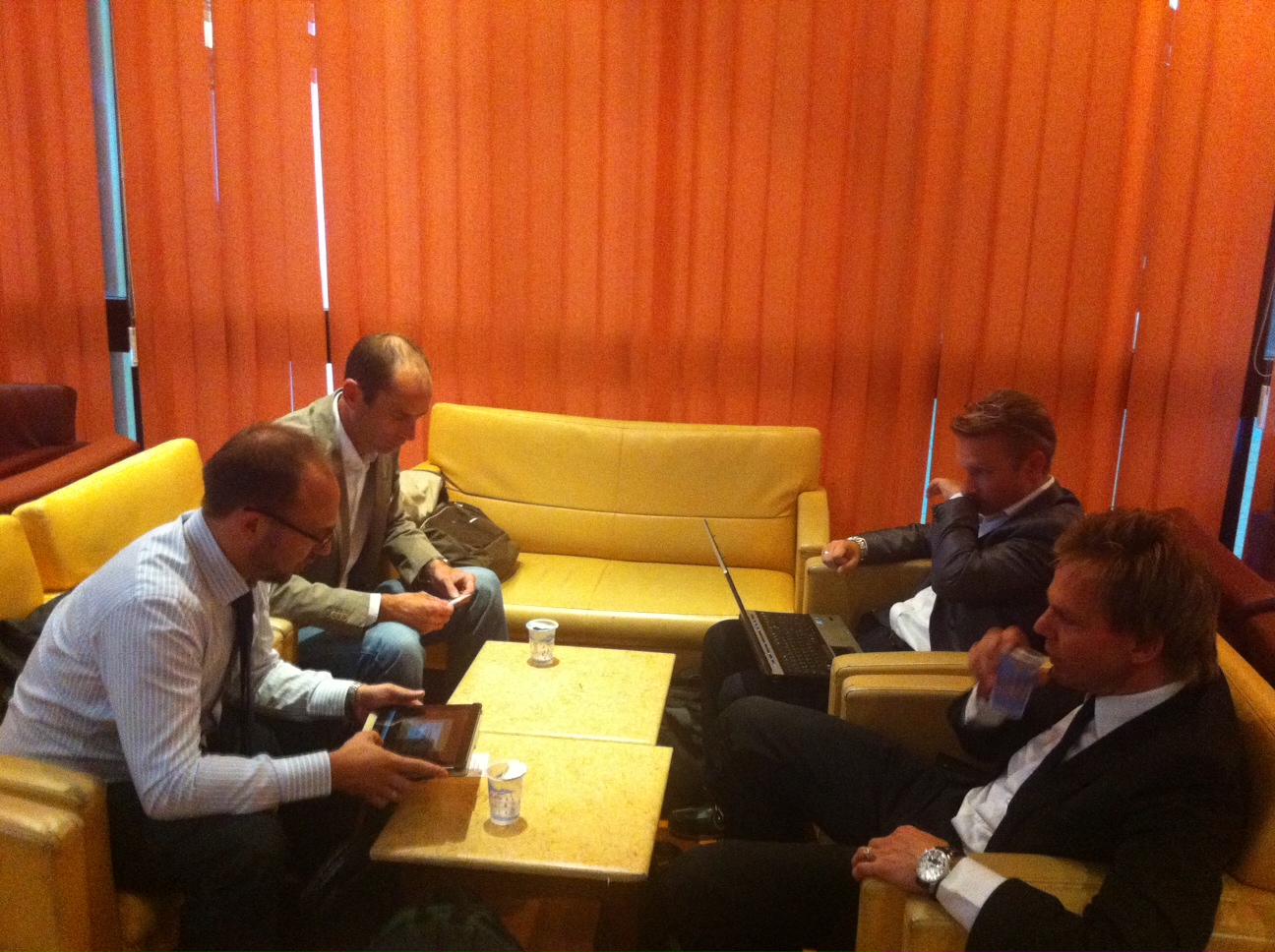
Österreicher unter sich auf dem Weg nach Wien

Ein Bild aus alten Zeiten (in Libyen sind drei Wochen bereits eine Ewigkeit, daher alt !): Österreicher bei der Ausreise aus Tripolis, gesichtet in der noblen Frequent Flyer Lounge des Flughafens. Ein wahres Vergnügen ist es dort. An (antialkoholischen) Getränken mangelt es nicht, das Essen kann schon das ein oder andere mal ausgehen. Also nx da Bäuche vollschlagen um den Flug nach Wien ohne Hunger zu überstehen. Das in der Economy Class servierte "Häppchen" reicht im Normalfall für die Energiezufuhr von 1 Stunde.
Aber zurück zum Thema: Auf der linken Seite macht sich die OMV Führung (GM Harald Scheruga und Exploration Manager Thomas Eder) zur Ausreise bereit. Eines kann man mit ziemlicher Sicherheit sagen: auf jedem Flug nach/von Wien trifft man einen der Ölexperten. Die Reisezeit wird eifrigst genutzt um die elektronischen Gadgets "auszuführen", die letzten Apps herzuzeigen oder die Nebengeräusch-ärmsten Kopfhörer zu testen. Oder man sieht sich gerade die letzten Produktionszahlen an, oder......aber nein, das darf ich jetzt nicht sagen was ich da am Bildschirm von Thomas Eder gesehen habe, denn die OMV ist ja ein börsennotiertes Unternehmen, und da würde jede Aussage den Aktienkurs verändern (Gleich ein Tipp für die Insider Aufsicht der Wiener Börse: Nein, ich selbst handle nicht mit OMV Aktien, und auch ganz unüblich für Österreich, auch keiner meiner Verwandten).
Rechts hinten studiert Peer-Christian Fritz gerade wie er sein erst kürzlich übernommenes Four Points Sheraton zum Laufen bekommt. Letztlich habe ich gehört, dass er den Weg gewaehlt hat, alle Angestellten einmal auf die Strasse zu setzen.
Einzig Stefan Mugitsch von der VAMED hält es ausnahmsweise einmal ohne Iphone, Blackberry, Mac o.ä. aus und delektiert sich an libyschem Wasser. 

Montag, 18. Juni 2012

OMV im Wandel

Jetzt geht´s ans Eingemachte. Wenn einmal der Technical Manager des Teams in Libyen, auch öfters auf diesem Blog als libysches "Urgestein" bezeichnet, dann ist Feuer am Dach. Gerhard Frey zieht den Hut und verlässt Libyen nach vier aufregenden, spannenden Jahren. Leider war der Abgang nicht ganz gewollt, aber was macht man, wenn das Land plötzlich als "non-family posting" kategorisiert wird und man gezwungen ist zwischen Wien, Kärnten und Tripolis zu pendeln ? Über einige Monate hindurch geht es gut, und bevor alles den Bach hinuntergeht, hat Gerhard zugunsten der Familie entschieden Abu Dhabi als neuen Standort auszuwählen. Erschwerend kam sicherlich auch hinzu, dass Gerhards Lieblingssport, das Windsurfen auch nicht mehr möglich ist. Zu gross die Gefahr, dass man von einem der neuerdings stark im Einsatz befindlichen "Bomb Fishers" aus Versehen das Surfbrett erwischt. Oder einer der übermütigen Waffenbesitzer ein kleines Zielschiessen auf einen Surfer veranstalten.
Viel Erfolg in Abu Dhabi, Gerhard und Petra Frey !
Thomas Eder (rechts auf dem Bild) hält weiterhin wacker die Stellung in Libyen.

Montag, 21. Mai 2012

Fishing for Oil - OMV


OMV is back to business in Libya since many months. Oil production is running at 90% of pre-revolution level (according to OMV press release) and the expat team is back to Tripoli.
What else do you want these days ? Especially, as business outside the oil sector is very slow.
So what can you do in your free time as an expat of a company that has a very tight security policy and which does not allow too much movement in town except from the office to the camp ?
Fishing is a good option. and it is the perfect sport for Libya: Get the fishing rod ready, put it out into the sea and wait for some fish to bite. You have to be patient. Sometimes very patient. And according to Harald Scheruga (General Manager of OMV Libya - on the right in the picture) the perfect training for the business environment: No fast movements, a lot of patience, and once the fish bites you have to be fast to catch it.

Fishing on the sea also brings another positive side effect: You meet other expats (in this case the General manager of a Turkish Oil company) and can discuss with them how to catch more fish.
The environment is a bit harsh, though. Especially when you live in one of the compounds: Most companies do not allow families of expats to travel to Libya, so the time after work, and especially the weekends can become very long.

One of the expats that had been in Libya before the revolution, Gerhard Frey of OMV, misses his family and thinks back with melancholy of the times when they were all living in Regatta. He could not stand that solitude in Libya anymore, so he decided to change and be with his family in another destination where OMV is drilling for the black gold. He will though need his arabic knowledge in the new posting.
Good luck Gerhard !

Mittwoch, 9. Mai 2012

Opening of Libya Youth Center


On May 8, over a year of hard work got rewarded: The Austrian energy group OMV financed a youth center for the treatment of traumatised children and youngsters. Hilfswerk Austria International, an NGO, was entrusted with implementing the project. Since a couple of weeks children have registered at the youth center and are trained by professional social workers.
Of course they also had a small performance during the official opening ceremony and it seems they all felt more than comfortable in their new environment.


Senior Vice-President David Lattin of OMV during the ceremony, Vice-Minister for Education, Dr.Khoja, and Secretary General of Hlfswerk Austria International, Dr.Heidi Burkhardt together cut the red ribbon.
It is indeed impressive, how, within only 6 months something real could be established. 

Mittwoch, 25. April 2012

OMV back to pre-revolution production


OMV is getting back on track, thanks to Libya. It took me some time to understand the article from the Austrian Broadcasting Service,  http://www.orf.at/stories/2116895/ so lets sumarise it:

OMV produced 299.000 barrel oil per day during the period 1-3 2012, after producing 304.000 barrel per day during the same period 2011. However, nothing is indicated about the exact production in Libya, just the info that 10% of all production comes from Libya.
So I guess the blue globe (see photo) will soon start getting bigger (eventually it has become bigger already, as the photo was taken some weeks ago...). Meanwhile, OMV staff  is quite present in Libya and produces together with its main foreign partner Repsol (Spanish) and local oil companies Libyan oil.
From other press releases it is known that OMV has reached nearly pre-revolution production in Libya.

Within the Austrian community OMV is also well known in Tripoli for having one of the strictest security regulations among foreign companies: No chilling out in one of the many bars and nightclubs in Tripoli, no shopping after sunset on Ghargharesh road (which is locally also referred to as "Rodeo Drive of Tripoli") and no possibility of getting in contact with one of the many other temptations Tripoli can offer.
Work as work can. And of course: Sport - they all have a very tight training program, their compound offers excellent facilities.
It is nice to be a purist.

Montag, 23. April 2012

Libya Youth Center, Dahra


Nina Boroufka, Project Manager of the "Libya Youth Center", enjoying her coffee after having worked non-stop for many months now. And the efforts shall be rewarded soon. Let´s start from the beginning:
Hilfswerk Austria International (HWA), an Austrian NGO started to focus its activities on Libya already during the early days of the revolution. Its secretary general, Heidi Burkhardt, travveled as early as April already to the Jebel Nafusa, delivering humanitarian aid to the war plagued "Rebels´ area".
After the fall of Tripoli, HWA continued their efforts, and also participated in a tendering process for the installation of a youth center for traumatised libyan children and teenagers.
The whole project was and is financed by the Austrian Oil company OMV and fits into their CSR (Corporate Social Responsibility) policy.


Nina started as project co-ordinator in Libya in November 2011 and made the nearly impossible, possible. Remember the old saying among foreigners: Libya, where the possible becomes impossible, and the impossible becomes possible.Within only a few months a house for the center was found, additional staff (e.g. psychologists) hired and the whole center was adapted to its specific needs.
Only a few days ago the first kids were received in the center. Actually it was the screening process to identify those children who need special attention and treatment. Nina and her team visit schools and kindergardens to also convince teachers of their work and the need to identify the children and teenagers in need of treatment.
These days the preparations for the grand opening are under way. Some more days, and you will read on this blog about it.
Oh yes, and if you have kids or teenagers who you think need treatment - feel free to visit them in Dahra !!


Donnerstag, 23. Februar 2012

Tanken um 8 Euro cent


Wer schon einmal in Libyen tanken war, der weiss, dass dies ein unglaublich entspannender Akt ist: man steckt den Zapfhahn in den Tank und lässt einfach unbekümmert das Benzin hineinlaufen bis es nicht mehr geht. Selbst Besitzer eines SUVs mit einem grossen Tank brauchen sich nicht zu fürchten, denn der Preis für einen vollen Tank übersteigt bei einem Preis von 8 cent/Liter die 10 Euro Grenze nie. Da bekommt man derzeit in Europa gerade einmal 5-6 Liter in den Tank.
Entsprechend unökonomisch wird gefahren (immer Vollgas) und man lässt auch schon desöfteren den Motor für eine Stunde laufen, wenn man auf einen Cafe geht (vor allem am Land ist diese Praxis sehr beliebt).
Der Preis ist nach der Revolution sogar noch gesunken, er betrug vorher 10 cent/Liter. Dieser Preis ist natürlich  gestützt, denn Libyen ist nicht Selbstversorger bei Benzin. In den Raffinerien in Zawiah und Ras Lanuf wird zwar wieder fleissig aus dem schwarzen Gold Benzin und Diesel hergestellt, aber die grossen Ausbaupläne, die Libyen zu einem Nettoexporteur von raffinierten Produkten hätte werden lassen, stehen momentan still.

Montag, 23. Januar 2012

Oil Industry in Libya


Zawiyah, January 2012: The refinery is up and running again. Providing at least part of the petrol and diesel needed in Libya. The rest is imported. Plans for expanding existing refinery capacities, like the huge project in Ras Lanuf, are put on hold.
But what is going on in the oil industry? I read a lot of comments and articles that the west and NATO have only come to Libya in order to get their oil afterwards. Sorry guys, but this is simply WRONG. Libya under Gadaffi did sell its oil already to the West. Without any conditions. It was very easy: The 1,6 million barrels per day were shipped mostly to European countries, and they paid well for it (world market price).
Of course, there were many IOCs (International Oil Companies) doing the exploration in Libya. At the end of 2010 there were about 50 of them around. The National Oil Company under its Chairman Shukri Ghanem started at the beginning of the 21st century to re-negotiate existing contracts and tendering new licenses. All this was being done under the so called EPSA IV contracts (Exploration and Production Sharing Agreement). A typically EPSA IV contract would leave the IOC with no more than 20% of all profits. With more and more companies pushing to enter the market, the share attributed to the IOCs became smaller and smaller. This led to the fact, that some auctions did not bring the big masses in foreign companies tendering, as prices went very high. Some companies even had to shut down their Libya operations (like Woodside/ AUS), or sell it (like Verenex / CAN) because of stiff competition and more profit being taken by the Libyan government.
All current production is performed under old contracts. No new contract has been awarded so far, and I also don´t expect this government to do any such action. This means that for the 1 mio - 1,2 mio barrel that are currently produced in Libya, the big share of income goes to the Libyan governemnt.
And hence in future hopefully to the Libyan people.

Donnerstag, 5. Januar 2012

Mellitah Oil & Gas


Die alterwührdige Mellitah Oil und Gas durfte ich besuchen. Praktisch die "Grande Dame" der libyschen Ölindustrie. Als Joint-Venture zwischen der italienischen ENI (AGIP) und der NOC (National Oil Company) betreibt man grosse Operationen in Libyen.
Eine kleine Änderung beim Eingang: Die Sicherheitsschleuse war nicht wie früher nur mit Abgabe von Pass, Eintragung ins Besucherbuch, kritische Blicke der allgegenwärtigen Security Leute und Warten möglich, sondern es genügte ein kurzes "I have an appointment with the Offshore Department".
Ein Lächeln, ein "Fadal" (übersetzt: Sie sind willkommen), und die Schleuse öffnete sich.

Die Suche nach dem General Manager der Offshore-Aktivitäten erinnerte ein wenig an alte Zeiten, denn das riesige Gebäude hat es in sich und ist nur äusserst mangelhaft beschildert.
Nachdem ich bei der Suche einer ganzen Reihe von Italienern begegnen durfte (die mich scheinbar als einen der "Ihren" hielten und mir freundlich "Bongiorno" zuriefen während sie ihren Kaffee genüsslich schlürften), fand ich das Büro der Offshore Aktivitäten.


Der Beweis dafür war auch im Wartezimmer zu sehen, ein Bohrturm in Miniaturausgabe. Auf meiner Suche nach dem richtigen Büro konnte ich feststellen, dass überall geschäftiges Treiben herrschte, aber ENI war ja bereits im September in Libyen und hat kurz darauf bereits wieder die Aufnahme der Aktivitäten angekündigt.
Derzeit werden eifrig alle alten Aufträge studiert und man versucht zu priorisieren, was zuerst benötigt wird. Die beiden grossen Öl- und Gas Offshore Aktivitäten, das Buri Feld (150 km nördlich von Zawia - seit 1987 in Betrieb) und das Bahr Aslam Feld (unmittelbar daneben) sollen jedenfalls bereits bald wieder in voller Produktion sein.

Mittwoch, 28. Dezember 2011

The (Austrian) hero from Tripoli


Finally ! A newspaper in Austria (actually the biggest one) came out with the story of the Austrian NGO "Hilfswerk Austria International"  http://hwa.hilfswerk.at/ working in Libya.
And especially for you, Asma (2nd photo), this entry is in English !
Heidi Burkhart, the CEO of Hilfswerk travelled already to Libya when others were still paralyzed by the events in Misrata and Eastern Libya. first aid deliveries arrived the Jebel Nafusa as early as April, more trips were to follow. By taking along Austrian journalists, Heidi made sure that Austrian media would report about the "rebels" in the Jebel, and some nice stories resulted from it.
When OMV decided within their CSR to launch a project for children and the youth in Libya "Hilfswerk" was invited to take part in the tender procedure, and finally they won it.
Their taking part in humanitarian projects from the beginning of the revolution made them an excellent partner.
Since October, Nina Borufka - Project Manager (oh, thx to the article I finally know her age :-D  - and Asma Khalifa are working day and night in our office. Preparing the opening of the Youth centre in the heart of Dahra.
1.500 children and teenagers will soon be treated with Art- and playful therapy of their traumas of the war.

And Asma?
Well, if she is not busy in organizing meetings with the Minister of Health, Minister of the Wounded, Minister of Education, etc. she is looking for a signal for her Wimax Internet connection.


Donnerstag, 17. November 2011

OMV eröffnet Büro in Tripolis


"OMV has re-opened its office in Tripoli and is fully comitted 
to be a reliable and successful partner 
of the new free Libya"


So liest sich das offizielle Statement des neuen General Managers der OMV für Libyen, Harald Scheruga.
Vorgestern war es dann auch soweit: nahezu die gesamte lokale Mannschaft ist zur Arbeit erschienen und nimmt ihren Dienst wieder auf. Die Expat-Mannschaft folgt in den nächsten tagen und Wochen. So hofft man die Produktion wieder in Bälde auf den vor-Revolutionsstand zu bringen. Derzeit hält man bei 30%.
Libyen hat am E/P Geschäft der OMV einen grossen Anteil, bei jeder Pressekonferenz der letzten Monate wird immer auf den Produktions- (und infolge auch Ertrags-)ausfall durch Libyen hingewiesen.
OMV war übrigens auch eine jener Firmen, die während der gesamten Zeit der Krise die Gehälter ihrer Mitarbeiter in voller Höhe weiterbezahlt hatten. Das hat sich nun bei der problemlosen Wiederaufnahme des Betriebes bezahlt gemacht.
Daneben hat man (gemeinsam mit VAMED und Asamer) mehrere Hilfslieferungen nach Benghazi geschickt.
Gelebte CSR (Corporate Social Responsability) ...

Freitag, 4. November 2011

An der Tankstelle - Ziltan


Tanken kann man noch immer (oder besser gesagt: wieder) sehr günstig in Libyen: 0,15 Dinar, umgerechnet 8 Euro cent kostet der Liter. Den Tank meines autos fülle ich um 4 Euro. Eigentlich ertsaunlich, in wie kurzer Zeit es der Übergangsrat geschafft hat, die Benzin- und Dieselversorgung im Land wieder herzustellen. Obige Tankstelle befindet sich in Ziltan, ca. 50km von der tunesischen Grenze entfernt. Nicht gerade eine Metropole, aber keine Autoschlangen wie in den letzten Wochen des Gadaffi Regimes zu sehen.
Der Standard ist zwar leicht verbesserungswürdig, aber was solls: Der Treibstoff fliesst, und ist darüberhinaus für die Bevölkerung leistbar. Derzeit kommt der Treibstoff nur zu einem kleinen Teil aus eigenen Raffinierien, denn Ras Lanuf ist nach wie vor nicht in Betrieb, und Zawia deckt den Inlandskonsum nur zu einem kleinen Teil ab.