Posts mit dem Label B: Gesundheit werden angezeigt. Alle Posts anzeigen

Donnerstag, 14. März 2013

Alcohol in Libya | Absolut Tripoli


What an irony, already 80 people died in Libya due to consumption of home-made alcohol in bad quality. Here it is called "Bokha" which is a distilled drink made out of dates. In Austria we would simply call it "Schnaps". On the countryside also many Austrians do their own alcohol, and it is well known that it can be very dangerous (deadly as we can see). I won´t go into detail about the tragic death cases - enough has been written in the media about it during the last few days. If you are interested, you might want to read more on the subject in the Libya Herald or even in many international newspapers.
However, the incident brings up a long discussed issue in Libya: Should alcohol be allowed ? And if yes, up to what extend ? Before the revolution it was said that Seif and his group would be backing very strongly a liberalisation of alcohol, as this would be necessary to develop Libya as s tourism destination. However, years passed with people telling international investors in the hospitality sector that it would be "very soon". Already then, there were strong forces in the government who opposed a liberalisation. Rather having no tourists than allowing alcohol (even if it were only in hotels).
The argument was (and still is) that tourists would come in big crowds, even if they would not find alcohol in Libya. Evidence shows a different picture: In 2009 an Italian tour operator started bringing Italian tourists to Dart Eleel (a then newly built hotel close to Sabratah). The idea was to see the magnificent Roman ruins and to relax a bit on an indeed beautiful stretch of Mediterranean beach.
Now imagine yourself a group of true Italian tourists, who, after asking for a cup of red wine for their dinner, were told "Malesh, mafish wine (sorry, no wine)". The news made its way to Italy, and after only very few weeks tourists stopped coming.
Hence, for the last few years (if there was not any other issue which hindered tourists from coming) the only tourism that flourished was the desert tourism.
After all, it is nice to see that a discussion started. I am curious to see the outcome.

Dienstag, 29. Januar 2013

Oncology Department, Tripoli Medical Center

About two weeks ago I was invited by some friends to join them for a visit and charity work during a Friday morning (in Libya Friday is a weekend´s day).
So I went to the Tripolis Medical Center, the biggest hospital in North-Africa.

The meeting point was the oncology-children´s department.
Have you ever been to an oncology department ? 
Though I am father of three kids, I have never been and I hope I will never have to go there on a regular basis like many of the fathers and mothers that I saw this day in the Tripoli Medical Center. 
What really disturbed me was to be in presence of kids who probably did not have many years of live in front of them anymore.
Pair this with the morbide environment of a big Libyan hospital, which does not have any kids-friendly attitude and you can start imagining  the mood there.


The group of young Libyans from www.volunteerlibya.org bought toys and handed them to the sometimes desperate kids. I felt they especially liked the presence of other persons than the nurses and doctors which are normally surrounding them. 

I took some toys from my kids, who have not been to Libya since the revolution. They were happy to know that their toys are still useful to somebody.

We came there during the morning visit of the doctor, however we could not tell clearly who was a doctor and who was a relative.
Some kids received their chemotherapy  on the gangway, others (like the girl on the top photo) were just sleeping after they had their post-chemo shock.

I spent around two hours there, but I was not unhappy being able to leave again.


Freitag, 2. November 2012

Austrian National Day


 Finally we could celebrate our national day. Actually it is on 26 October, but on that day Eid Kebir was celebrated in Libya, so it had to be done on another date.
Last thursday Ambassador Hörlberger and his wife invited approx. 200 persons to the Mahari Hotel Radisson in Tripoli.
And many followed the invitation, making it a memorable evening.


However, first we needed to get over the obstacle of getting the flag right. It needed some explanation how to put it.
Maybe after "Felix" jumped from outer space, hotel staff thought that our national "bird", the eagle, also had to be upside down. "Same same like Felix".
Luckily I could convince them that not all of us come upside down.


 Asma Khalifa, from the Libya Youth Center acted as our translator - not the first time. And as usual, she did a very nice job.
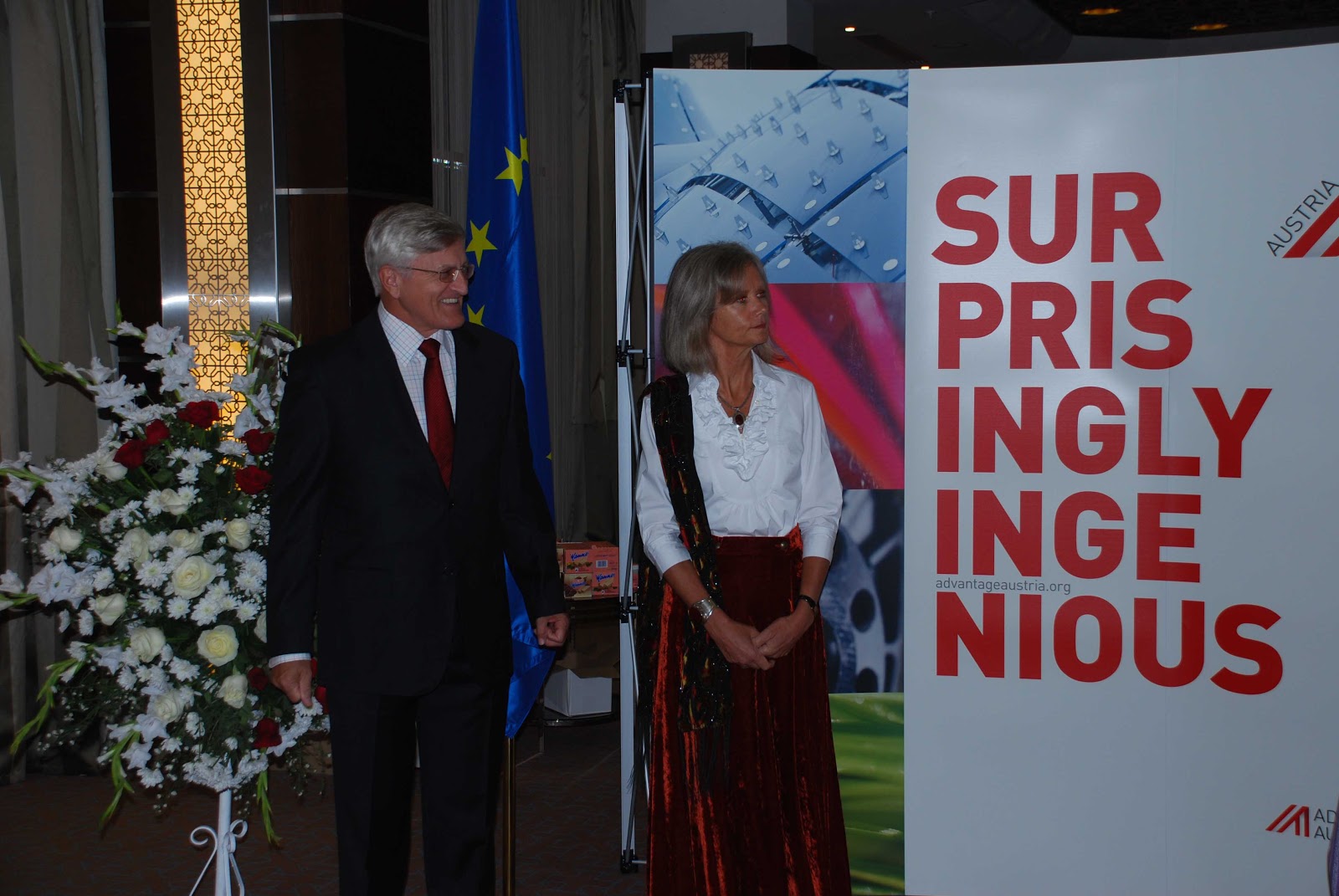
Oh, yes, the strapline for our national day was being "surprisingly ingenious" - the new slogan for our foreign trade organisation "Advantageaustria" (www.advantageaustria.org)


We sould not miss out on Austrian sweets. Generous support of Austrian companies that export their products to Libya, such as: Manner, Rauch, Spitz, Pago, Pfanner, Red Bull made it possible that guests could taste a wide variety of products.


We felt especially honored that many high level politicians such as outgoing Ministers Hamroush (Health) and Tarbel (Youth and Sports), on picture, or new Ministers (such as Abdulaziz) and Members of Parliament attended our national day.
Also remarkable is the fact that so many Libyans attended. During the last few years this group was a minority. And most of the people who came were already known, because they attended all national days and were either very close to the regime, or reporting in one way or the other.


Dienstag, 30. Oktober 2012

30 Jahre VAMED

Wenn man 30 Jahre ein Unternehmen gut über die Runden gebracht hat, darf man schon einmal feiern. Und dann darf man auch schon einmal patzen, und nicht kleckern.
So geschehen, als vor einer guten Woche Ernst Wastler, seines Zeichens Vorstandsvorsitzender der VAMED AG, in die (ebenfalls von VAMED renoviert und betriebenen) Therme Wien nach Oberlaa geladen hat.
Alle waren sie gekommen: Minister, Vorstände, Aufsichtsräte, Ärzte, Interessensvertreter - einfach einmal so alles was unsere Alpenrepublik so zu bieten hat.
Ach ja - und ein Wirtschaftsdelegierter. Um falschen Gerüchten gleich in Zeiten von Untersuchungsausschüssen vorzubeugen: Das Flugticket von Libyen nach Wien habe ich selber gezahlt.
Bereits beim Eingang wurde mir bewußt, wieso gerade jemand aus Libyen eingeladen wurde (ich): Tripolis war und ist  für die VAMED einfach ein wichtiges Pflaster. Das sah man bereits beim Empfang, wo neben Wien, Peking und Bogota, auch die Uhr von Tripolis hang. Und eine Wohltat: Endlich eine Firma die wußte, dass man Tripolis mit einem s am Schluß schreibt. Andere Unternehmen, wie beispielsweise Austrian Airlines, wehren sich ja in der deutschen Version der Mittelmeermetropole beharrlich gegen das s, und so lassen dann auch Kabinenpersonal das s weg, sodass man glauben könnte, es sei ob eines lispelnden Sprachfehlers, den die Piloten zu verbergen suchen.
Aber zurück zur VAMED.  Es folgten Ansprachen von Gesundheitsminister, Aufsuchtsratvorsitzenden, Wirtschaftsminister, WKÖ Präsident, AK Präsident, und, und und...
Dazwischen immer wieder hochklassige Musik/Tanzeinlagen.
Über Einspielungen gratulierten alle Landeshauptleute, ja selbst unser Bundespräsident.
Fehlen durfte auch nicht der Vizekanzler. Der war ja für Libyen und VAMED sehr wichtig. In seiner Rede erwaehnte er, dass das Spital in Libyen (Tripoli Medical Center), das von der VAMED betrieben wird, das größte in Nordafrika sei, und auch während der gesamten Zeit der Revolution keinen einzigen Tag geschlossen war (hmmm, ob dies am 20/21/22 August 2011 auch so der Fall war bezweifle ich ein wenig, aber man darf jetzt nicht kleinlich sein, ist fürwahr eine Leistung). Schön auch den Einsatz von Politikern bei Auslandsreisen zu sehen, denn anlässlich des Besuchs des Vizekanzlers und Aussenministers in Tripolis am 9.10.2011, so erzaehlte er weiter, wurde auch der Übergangsregierung abgerungen, dass der VAMED alle ausständigen Zahlungen beglichen werden. Wie ich an diesem Abend erfuhr, stand man von libyscher Seite zu diesem Versprechen. Gratuliere ! Das würden sich manch andere österreichische Firmen nur wünschen.
Aber vielleicht gibt es ja eine Wiederholung !

Gratulation VAMED zu diesem wirklich gelungenen Event.
Setzt Maßstäbe.

Sonntag, 27. Mai 2012

Austrian Air Force in Libya


The pride of the Austrian Air Force: Hercules C-130 arrived in Tripoli on 3 May. On board: 18 medical doctors, nurses, physotherapist, in total 30 persons.
Wafa (we are for all) helped organize this humanitarian trip initiated by the Society for Austro-Arab Relations, during which many operations, consultations and therapies were carried out.
But why would they not take Austrain Airlines www.austrian,com , flying five times a week Vienna-tripoli?
Was it because of the catering?
Or maybe comfort?
Or did the pilots need some training hours ?
No, the real reason was that tons of medical supplies and equipment was brought to Libya. Donated by Austrian companies an institutions.

Although, when our beautiful bird arrived at Tripoli international airport, the usual confusion broke out:
"Why is this plane here?"
"Where are the visas?"
"Where are the import licenses for the goods?"

After grilling two hours on the rollway, everything was resolved.
"Mafish mushkila"

If you are interested in more activities of the Society for Austro Arab Relations (GÖAB-SAAR) pls. follow the link:
www.saar.at 

Freitag, 23. März 2012

No smoking in Spitälern


Jetzt ist es also soweit: Libyen hat auch seine Liebe zu den weltweit auf dem Vormarsch befindlichen Rauchergesetzen gefunden. Mit sofortiger Wirkung wurde Rauchen in Krankenhäusern verboten. Vorbei ist die Zeit, als man bei einem Patientenbesuch im Krankenzimmer rauchen konnte. Oder vor dem OP Saal (im OPSaal habe ich es dann doch nie erlebt) ein Arzt nach einer anstrengenden Herz OP den Stress mit einer Zigarette hinunterkippen konnte.
Ja, Libyen wird ein richtig fortschrittliches Land.

Donnerstag, 1. März 2012

Besuch im Tripoli Medical Center, VAMED


So sieht es aus, wenn Diplomatie und Wirtschaft hand in Hand gehen:
Stefan Mugitsch, langjähriger General Manager der VAMED (www.vamed.com) lud zur Führung durch das Tripoli Medical Centers (TMC), dem größten Spitals Afrikas. Für den neuen österreichischen Botschafter, Franz Hörlberger, war dies der erste Besuch bei einer österreichischen Niederlassung, im Laufe der nächsten Wochen sollen andere Folgen.
VAMED hält (neben anderen) einen Vertrag über die technische Betriebsführung dieses 1.400 Betten Spitals.
Im Spital gab es einen Besuch beim neuen Direktor, dem allseits als integren Mann anerkannten Dr.Khaled. Er hatte bereits etliche Jahre im TMC gearbeitet, bevor er nach England ausgewandert ist um dort die letzten Jahre zu verbringen. Zu Aussichtslos erschien ihm damals die Situation in Libyen, die alte Regierung habe "keine Interessen am Wohlergehen des Menschen" gehabt. Es liegt jetzt an ihm, dies in einem mühevollen, anstrengenden Prozess zu ändern.

Samstag, 28. Januar 2012

Austrian Medical Team in Sabratah Hospital


On a beautiful Friday, the new Austrian Ambassador and me were invited to visit Sabratah and have a tour through the municipal hospital. Well, there are not so many other exciting options these days, and in addition one does not find every day a group of Austrian medical doctors in action in Libya.


The initiative came from the Society for Austro Arab Relations (Gesellschaft für Österreichisch-Arabische Beziehungen www.saar.at )  and its Secretary General, Fritz Edlinger. Together with their Libyan Partner, Wafa Relief and Development, they brought up the idea of visiting Libya with a grou of Austrian doctors in order to carry out some medical work (mainly operations). The medical doctors are from different fields  (Plastic surgeons, sureons, gynecologist,...) and all used their holidays to perform operations free of charge for those in urgent need in Libya.


The hospital itself is a huge building from the 1970s and obviously in need of some refurbishment. However, the doctors said, they have seen worse, like in Yemen for instance. The biggest problem in Sabratah seems to be the lack of proper equipment and, in some departments, a catastrophic hygienical situation which makes some operations impossible. The operation might be a success, but the patient would die thereafter due to the infections by different bacterias.


Well, to say the least, the pre- and post-operation rooms (see pictures) do leed me to the deep hope that i do not need to undergo an emergency operation there.


Two female doctors (plastic surgeons) from the famous Viennese hospital "Rudolfsstifutng", Prof. Deutinger and Dr.Gösseringer, together with Dr.Schwarzinger (anethesist) were intensively at work, operating a three year old child. The surgery was succesful and the happy father could hold his kid in his arms only shortly thereafter.


Even the TV came, "Libya TV" made an interview with the two succesful doctors. The Ambassador also pointed out, that this should be a good example and encourage libyan women to engage in higher qualified jobs.
Libyan doctors in Sabratah were very thankful for the support. In addition to receiving immediate support for some complicated cases, they also learn from their Austrian colleagues some new techniques. The the Austrian doctors it is also interesting and enriching to see how their Libyan counterparts handle complicated cases.
The whole mission was a success, during 5 days many operations could be performed. also such patients were identified that could not receive proper treatment in Libya and need to be brought somewhere else.
Fritz Edlinger of the SAAR said, that this was the first mission of its kind. But after having put feets on the ground, the current fact finding mission will be followed by a much larger group of Austrian medical doctors.
cases. 

Sonntag, 8. Januar 2012

Ministry of the Martyrs


Ja, soetwas gibt es tatsächlich: Seit 22.November 2011, mit der Angelobung der neuen Regierung wurde ein eigener Minister für die Märtyrer (Gefallenen) und die Verwundeten gegründet. Hauptaufgabe ist die Versorgung und medizinische Behandlung der Verwundeten sicherzustellen.
Bei einem Besuch im Ministerium fallen einem natürlich sofort die vielen Verletzten und Kriegsversehrten auf, die dort ein- und ausgehen.


Das Ministerium ist in einem Gebäude untergebracht, dass ehemals einem Familienangehörigen des Gadaffi Regimes gehörte. Das Zelt vor dem Pool (sehr stilsicher mit eigenem Wüstensand im Zelt) zeugt noch von anderen zeiten. Das war es dann aber auch schon: Im Inneren herrscht geschäftiges Treiben.
Der Termin fand gemeinsam mit der österreichischen Firma VAMED statt, denn diese ist bereits seit über einem Jahrzehnt in Libyen erfolgreich tätig.
Aber jetzt will man von Ministeriumsseite nichts mehr mit Firmen zu tun haben. Denn in den letzten Wochen gehen die Wogen hier bei jedem Vertrag, jeder auch noch so kleinen Ausgabe hoch.
Unlängst kaufte das Tripoli City Council Telefonkredit zum Wiederauffüllen der Pre-Paid Mobiltelefone in Höhe von ca. EUR 1.000. Dies führte zu lautstarken Proteste vor dem Hauptsitz der Stadtregierung. Da darf es nicht weiter wundern, wenn jeder sich scheut bei grösseren Verträgen die Finger zu verbrennen.
Und es warten noch 2.000 Verwundete (Spezialfälle) auf Behandlung. Idealerweise in Österreich....so wünscht man es sich zumindestens seitens des Märtyrerministeriums.


Samstag, 10. Dezember 2011

"Thuwar" im UKH Graz


Gestern besuchte das Team des AC Tripolis, das sich gerade auf Teambuilding in Österreich befand das Unfallkrankenhaus Graz: Eine richtig "libysche Aktion", denn erst am Tag davor erfuhr ich durch eine Presseaussendung der AUVA (http://www.ots.at/presseaussendung/OTS_20111207_OTS0098/auva-betreut-libysche-kriegsverletzte), dass sich libysche Kriegsverletzte zur Behandlung in deren Spitälern befinden. Die Vorgeschichte war bekannt, denn Österreich bot bereits durch Vizekanzler Spindelegger beim Besuch in Tripolis Anfang Oktober an, libysche verletzte Freiheitskämpfer in österreichischen Spitälern zu behandeln. Nach einigen Wochen Vorlaufzeit war es dann vor einer Woche soweit, und das TFM (Temporary Finance Mechanism) schicket die ersten Patienten. Bereits nach einigen Tagen kam ein Dankschreiben an die österreichische Botschaft Tripolis, das die vorbildliche Behandlung lobte (http://www.ots.at/presseaussendung/OTS_20111202_OTS0263/libysche-uebergangsregierung-dankt-oesterreich-fuer-medizinische-betreuung-von-verletzten).
Also wurde kurzerhand Frau Dr.Leeb, Pressesprecherin der AUVA angerufen, die binnen kürzester Zeit einen Besuch unter Begleitung des ärztlichen Leiters, Prof.Dr.Tax, ermöglichte.
Wir besuchten drei blutjunge Libyer, die beim Kampf um Sirte schwer verletzt wurden. Einer von Ihnen verlor seinen Vater, wurde selbst in den Bauch getroffen und hatte einen Oberarmbruch. Ein zweiter wurde in derselben Schlacht getroffen, kam aber mit einem Oberschenkel Durchschuss noch glimpflich davon. Der Dritte wurde in den Kopf getroffen und wird wohl nie wieder ganz rehabilitiert werden.
Alle freuten sich zumindestens für eine Stunde "libysch" reden zu können und erzählten ihr Schicksal. Besonders gefreut haben sie sich über die von uns mitgebrachten libyschen Datteln, die gleich verzehrt wurden.
Die Attraktion war aber eindeutig meine Kollegin Ana Grünwald (blonde Haare), mit der sich alle ablichten lassen wollten. Die Erheiterung war perfekt als sie auf arabisch sagte "Ana Ismi Ana" - wörtlich übersetzt: "Ich heisse ich".
Die Betreuung kann sich sehen lassen, neben der perfekten und modernen medizinischen Betreuung stehen rund um die Uhr zwei arabisch Dolmetscher zur Verfügung die auch gleich einen "crash-Kurs" in Deutsch einbauen (siehe Fotos).
Die deutsche Almeda (Tochterunterunternehmen der Münchner Rück) hat übrigens die Abwicklung übernommen.

Samstag, 5. November 2011

Stau der Rettungsfahrzeuge in Ras Ajdir


Die Diplomatenspur beim Grenzübergang in Ras Ajdir ist mit Rettungsfahrzeugen verstopft. Der desolate Zustand der Krankenhäuser bzw. des gesamten Gesundheitswesens lässt Libyer zur Behandlung nach Tunesien fahren. Viele EU Länder haben in den letzten Tagen auch Kriegsverwundete aufgenommen, bei einer Reise nach Tunesien erübrigt sich allerdings die Visaproblematik. Dennoch heisst es an der Grenze die Formalitäten zu erledigen. Tunesische Spitäler sind gut gefüllt von libyschen Staatsbürgern, die Behandlungskosten werden vom NTC getragen.